
Direct bookings · Guest history · AI-ready
Turn a booking into a returning guest.
G-Guest takes the booking, refills the cancellation and brings the guest back, quietly, while you run the day.
- Restaurants & cafés
- Salons & barbers
- Beauty & wellness
- Studios & classes
- Clinics & practices
Different capacity. Same guest journey. books tables and seats
The first 25 reservations are on us, and we set it all up
Your page, your hours, your tables, built and tested by us in a day. Free until 25 confirmed reservations, up to 60 days. No card, not a cent. And the page is yours to keep: it stays online even if you don’t stay.
Live on this page, not a mockup
Don't read about it. Make a real booking
This is the live G-Guest widget running against a demo business. Pick a date, a time and an available spot, exactly as your customer would.
The same engine books a table, an hour with a specialist or a place in a class. It goes onto your website with one line of code: your name, your capacity, your brand.
What bookings quietly cost
Four leaks in an ordinary week
None of them look like a problem on the day. All of them are money.
The phone in the middle of service
Every call answered is a guest in the room ignored, and the call nobody answers is a table booked somewhere else.
Fees on guests who were already yours
Marketplace apps take a cut of “new” clients, including the ones who searched for your name and would have come anyway.
The no-show nobody refills
A table dropped at six stays empty at eight. Without a waitlist, that revenue is simply gone.
The guest who asked their assistant
People now ask their phone where to book. If your booking can’t be read and completed, the recommendation goes next door.
G-Guest closes all four, and every booking and every guest it takes stays yours.
60 days free. No card. No call.We set it up.Search is becoming action
Being found is no longer enough
AI has moved from recommending local businesses to acting for customers. Google Maps can turn a food search into an order in the US, and AI Mode now surfaces live table availability inside the answer, worldwide. The guest still taps to confirm, but the shortlist is built before they ever reach your site.
Which makes the question simple: can AI actually book your business?
Free AI Bookability CheckTerrace at Balangan
Mediterranean · 4 min
19:0019:3020:15Osteria Nusa
Italian · 7 min
18:3020:00- ·
Warung Pantai
Seafood · 3 min · 4.8 ★
The Cliff Kitchen
Grill · 9 min
19:4521:00
Three of these have machine-readable availability. The fourth is a fine restaurant with a lovely website. It is not on the list.
Everything it does, in one screen
Book. Fill. Know. Review. Return
Five stages of the same guest, one system. Each one is a place a business quietly loses money, or loses the guest.
Your team
The day runs without you in it.
- Booking alerts to every phone running the shift
- A staff link that opens the day, never your settings
- Morning digest: who's coming, how many
- Walk-ins in two taps, a closed day in one
- Personal schedules and buffers: John works Tue to Sat
- A live panel, with AI-made bookings labelled
No marketplace in the middle
Your bookings. Your guests. Your relationship
Marketplaces rent you demand and charge a fee every time somebody books, including the regulars who were already yours. G-Guest converts the traffic you already own: your site, Google, social, word of mouth, AI answers.
€0
per booking, ever
Yours
guest base, exportable in one click
€49/mo
flat, + tax, everything included
AI-ready
a booking interface assistants can call
Book
One booking system. For people and AI
Customers book real availability directly, and confirmation is instant by default. Need the customer to confirm, or to pay a deposit first? You choose. You keep the relationship and pay nothing per booking.
- Your site or booking page
- Real availability
- Confirmed
An assistant joins at the same availability layer, not a separate product, and not a form it has to click.
Fill
A cancellation shouldn’t mean lost revenue
When a booked spot opens up, G-Guest moves through the waitlist by itself. Nobody phones people one by one, and the opening doesn’t quietly disappear from the day.
- Full
- Guest joins the waitlist
- Capacity opens
- Next in line is told
Oldest request first, one person per opening. The spot is not held: it goes to whoever books first, and the message says so.
Know
A booking isn’t a visit
Future bookings don’t make somebody a regular, and cancellations certainly don’t. G-Guest remembers who actually came, tells a confirmed visit from a presumed one, and builds guest status out of real history.
Notes ride along: “window table”, “allergic to nuts”, “prefers John”. The base is yours to export in one click.
- New
- Returning
- Regular
A cancellation is not a visit
A future booking is not a visit
Review
Five stars say you’re good. Details say what you’re good for
After a visit, G-Guest asks for the detail that makes a review useful: what the customer experienced, and why they came. Requests rotate across the destinations you choose instead of pushing everyone to one platform.
- Visit happened
- Prompt about the experience
- The platform you chose
“Quiet enough to work in” answers a question that “great place!” never will, for a person reading it, and for an assistant recommending you.
Return
Bring guests back without becoming annoying
Return messages go only to guests who chose to stay in touch, use real visit history, and check recent contact before another marketing message is allowed. Confirmations and reminders are operational and always go through.
Six months in, you’ll have something no platform can take away: a guest book that’s actually yours.
Sometimes the right message is no message.
- Guest agreed to hear from you
- Contacted recently?
- Yes: silence
- No: eligible
Your rules
Instant when you want it. A deposit when you need it
A restaurant table, a haircut and a studio class don't need the same booking rules. Keep instant confirmation, ask the customer to confirm, or require a deposit, and G-Guest follows your setting without anyone checking each request.
Instant booking
DefaultConfirmed on the spot
- Picks a time
- Confirmed
Nothing to switch on. This is how G-Guest works out of the box.
Guest confirmation
One tap from the guest
- Picks a time
- Taps the link in the email
- Confirmed
Not tapped in time? The slot goes back on sale by itself.
Prepayment
Confirmed by the payment
- Picks a time
- Pays into your Stripe
- Confirmed
The payment is the confirmation. No second step, even with guest confirmation on.
Not paid in time: the slot goes back on sale, nothing is charged.
* Online prepayment needs your own Stripe account, available to venues in every EU country, the UK, Switzerland, Norway, Liechtenstein and the US. Stripe's processing fees apply; G-Guest adds no fee of its own. You don't need Stripe to use G-Guest.
Prepayment, when you want it
Taking deposits shouldn't become your evening job
Set the amount and how long customers have to pay. They see your refund terms before checkout and pay straight into your own Stripe account.
G-Guest checks the payment with Stripe and confirms the booking. If an unpaid hold runs out, the slot is back on sale by itself.
No payment screenshots to check. No transfers to match by hand. No cut for G-Guest.
One slot, start to finish
- Available
- Awaiting payment
- Confirmed
Payment window runs out: available again, automatically.
Paid and closed the tab: confirmed anyway, within minutes.
Set the amount
Per booking or per person, and a different amount per service, or none.
Set the deadline
From 30 minutes to 24 hours to pay. The time is held until then.
Keep control
Your Stripe, your refund terms shown before checkout, refunds made by you.
* Online prepayment needs your own Stripe account, available to venues in every EU country, the UK, Switzerland, Norway, Liechtenstein and the US. Stripe's processing fees apply; G-Guest adds no fee of its own. You don't need Stripe to use G-Guest.
Waitlist, visit history and the review layer, all of it, flat.
Built around how your business takes bookings
Your trade not on the list?
These are examples, not a fence. If your business books a table’s worth of people, one specialist’s hour, or places in a group, G-Guest fits.
book · visit · remember · return
One honest limit: G-Guest is not for hotels. It books the day: tables, appointments, class spots, not overnight stays.
Your team’s side
Everyone who needs the booking sees it. Nobody needs your login
Booking alerts go to the phones that actually run the shift: the owner, the floor, the front desk. Staff access opens the day’s bookings and nothing else: your settings, your guest base and your exports stay yours.
- Owner phone
- Shift phone
- Front desk
- One live booking view
Nothing is required from you. That’s the whole point.
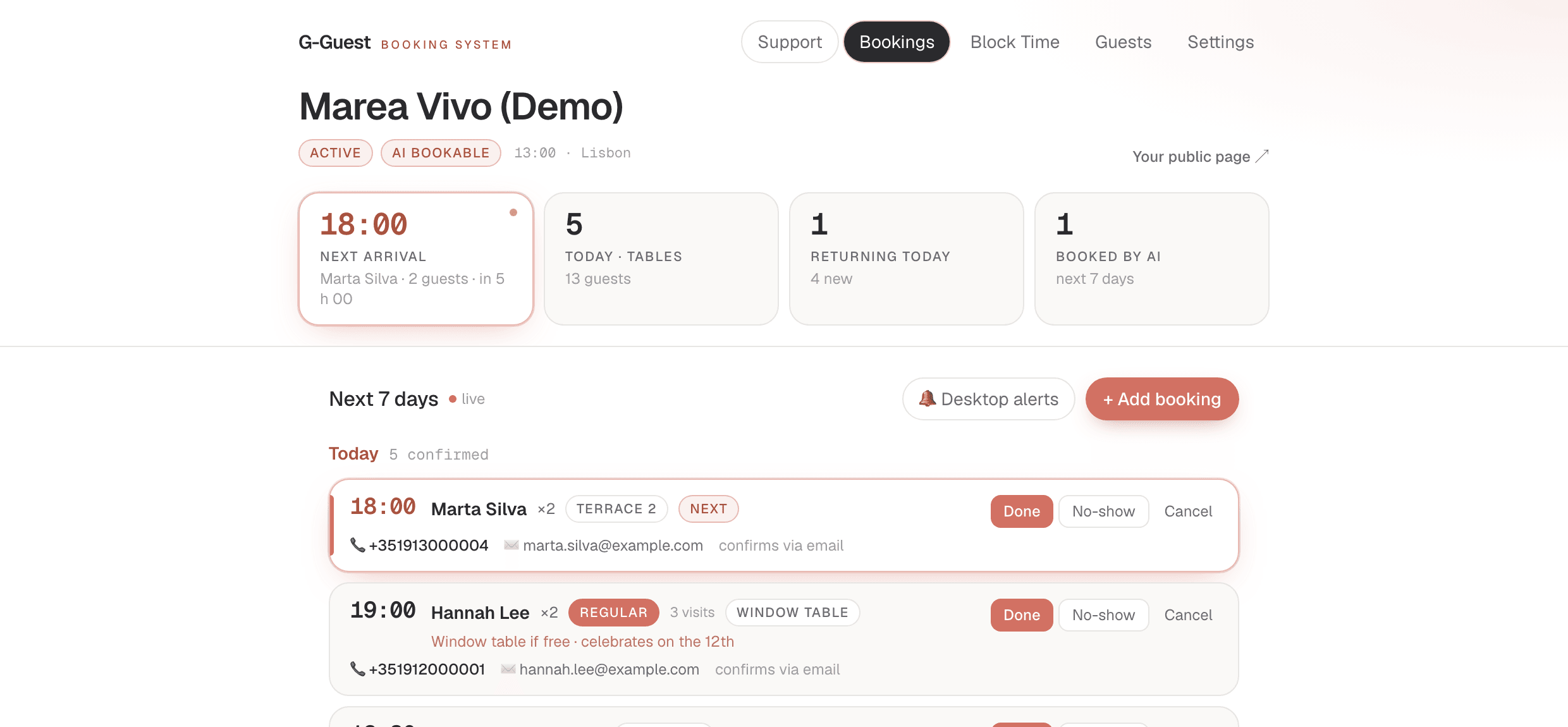
The real panel of our live demo venue. Mark a guest arrived in one tap.
Fully customizable
It works the way your place works
A tapas bar, a barber and a yoga studio don’t book the same way. Every rule below is yours to set, change on a busy Friday, or leave to us: we set it all up with you on day one.
Hours
Opening hours and time off
Your hours for each day. Close the rest of tonight, a whole day or a private event in one tap.
Rules
Booking rules
How often start times are offered, the largest party that books online, the minimum notice and how far ahead guests can book.
Team
Your team
Each person once, with what they do. Their own hours live on their own link.
Alerts
Alerts where you want them
Email, Telegram or both, on as many phones as you like. Every new booking lands the moment it is made.
Follow-ups
Reviews and WhatsApp
Guests you mark as done get a friendly review request a few hours later. Add your WhatsApp and it appears on their confirmation.
Confirmation
Guest confirmation
Want guests to confirm with one tap before a booking is final? Switch it on. Not confirmed in time, the slot goes back on sale by itself.
Prepayment
Deposits, when you want them
Per booking or per person, your own amount per service, your refund terms. Guests pay into your own Stripe, and the payment confirms the booking.
Access
Staff see today, not your data
Staff get their own link to the day's bookings. Settings, guest list and exports stay with you, and a link can be reset any time.
Integrations
Your own API key
Connect G-Guest to your own site or tools when you are ready. Nothing to install to start.
Your capacity, your team, your guest base.
How a booking flows
One booking, and everything stays yours
No marketplace in the middle taking a cut and keeping your guests. The whole path runs on your own site, and ends with you.
Your own site
A guest arrives on your site, not a marketplace
Books a real slot
Picks a time and is confirmed on the spot
Becomes a guest
Named, reminded, and remembered next time
You keep the money
No per-booking cut, not even on regulars
Contacts stay yours
The guest book is yours to keep and export
The platforms rent you guests and keep the list. Here, the guest was always yours.
Built for people. Ready for their AI
Every G-Guest business is AI Visible: a structured public page with stable facts an assistant can read, and AI Bookable: live availability and a booking action designed for assistants to understand and use. We measured how far an assistant actually gets today. The study below is restaurant-specific: 200 Amsterdam restaurants, one method, one week. It is evidence about the booking gap, not a claim about salons or studios.
Measured, Amsterdam 2026
Every step loses half the restaurants
We ran 200 Amsterdam restaurants through the same checks, in the same conditions, on the same day. This is how far each one gets before an assistant runs out of road.
↓ 84 drop out here
↓ 47 drop out here
↓ 16 drop out here
↓ 16 drop out here
G-Guest sits on this last rung. Not one restaurant in the sample publishes a booking interface an assistant can call. Ours does, and independent agents have used it to create confirmed reservations.
n=200 · random sample, fixed seed · Amsterdam municipality · July 2026 · no reservation was ever submitted
Every venue we measure gets an AI Bookability Check : the public method behind our research. Installing G-Guest is one way to raise yours: the agent-booking measure moves the day the widget goes live, and we re-measure to prove it.
€49 a month + tax, flat. No fee on a single booking.
People asking AI to find a local business
6%
a year ago
45%
this year · BrightLocal, 2026
80%+
next year: our expectation
And yet: of 163 random restaurants’ websites in our field study, 0% could be booked by an assistant.
Invisible to assistants means passed over: the booking goes next door. We make you readable, and bookable, from day one.
Three ways to take a booking
A marketplace, the booking widget bolted onto a site builder, and your own system. They look alike from the outside. They are not.
| Marketplace | Basic booking widget | G-Guest | |
|---|---|---|---|
| Who owns the guest | The marketplace | You, in their database | You, exportable any time |
| Cost per booking | A fee on every one | Usually none | None, ever |
| Cost per person on your team | Per staff member | Per user | The same at one and at ten |
| Real visit history | Their side only | Rarely | Yes: visits, not just bookings |
| Waitlist on a cancellation | Sometimes | Rarely | Yes, automatic |
| Deposits against no-shows | On their terms, if offered | Sometimes | Optional, into your own Stripe, no cut |
| Review follow-up | To their platform | Rarely | To the platforms you choose |
| Return messages | Their marketing | No | Yours, with consent and a silence rule |
| Bookable by an AI assistant | Inside their app | No | Yes, from your own site |
If a marketplace genuinely brings you new customers, keep it; some places run both. What many discover is that most of their bookings were coming from their own name all along.
What this actually is
Not another booking system. An action layer
Google made local business discoverable. A website made it understandable. Neither made it actionable. An assistant can read about you all day and still not be able to do the one thing your guest asked for, which was to book you.
Discover
Search and AI answers find you. This part the world already solved.
Act
An assistant checks your real times and completes a real booking. This is the part nobody built.
Return
The visit is remembered, and the guest comes back to you rather than to a search box.
A website made your business clickable. G-Guest makes it callable: a machine address where an assistant can ask what you offer, when it is free and what it costs, and then book it. Every local business is going to need one.
Restaurant platforms solved this for restaurants that can afford them. The groomers, physios, tutors, studios and repair shops were never invited, and an assistant still has to be able to book them.
One flat price. No fee every time you succeed
€49 a month + tax, everything included. Cancel any month.
Flat means the busier you get, the cheaper it gets: a hundred bookings a month is €0.49 a booking; two hundred is €0.24. Marketplace fees work the other way: they grow with every booking.
What €49 a month includes
Light booking and guest infrastructure, complete. Flat price, no commissions, cancel any month.
- Your own public booking page on the G-Guest domain: no website required
- Direct bookings, confirmed in seconds day or night, without you touching a thing (deposits too: confirmed automatically once paid)
- A booking form for your own website in your colours (arrives with activation, not part of the free trial)
- A waitlist that refills cancellations
- Guest history and real visit states: new, returning, regular
- Review requests routed across the platforms you choose
- Return messages with consent, and a silence rule
- Booking alerts on the phones that run the shift
- Readable and bookable by AI assistants from day one
- Eight guest languages the page, the form and every letter to a guest; we translate, you do nothing
- Your concierge a human on Telegram: text or voice, in your language, setup done for you
€49 /mo + tax
Local tax added at checkout where it applies. No per-booking fees. Your guest base stays yours.
Or activate now and skip the trial.
Cancel any month: your guest base exports with you. Everything stays yours.
Already have a website?
Your site starts taking bookings on day one
Put your G-Guest page link behind the Reserve button you already have and guests book real slots with instant confirmation from the first day of the free start. Nothing to install, nothing to rebuild.
When G-Guest becomes permanent, we also build a booking form in your colours for your own website as custom work, made to match your site, one line to add. (This part arrives with activation: it isn’t included in the free trial.)
The free start
Twenty-five reservations from now, this is just how bookings work
Your venue’s name and an email: that’s the whole form. We build your booking page, guests book real slots day and night, and you watch it happen for your first 25 reservations. If it doesn’t earn its place, walk away: no credit card, nothing to cancel, and your setup stays saved for whenever you return.
FAQ
G-Guest: frequently asked questions
What kinds of businesses can use G-Guest?
G-Guest is a booking system for restaurants, cafés, bars, salons, barbershops, beauty and wellness studios, spas, yoga and fitness studios, classes, and clinics, any small business with bookable time or limited capacity.
What each one books:
- Restaurants & cafés: tables and seats
- Salons & barbers: appointments, chairs, specialists
- Beauty & wellness: appointments, treatment rooms, practitioners
- Studios & classes: classes, spots, instructors
- Clinics & practices: appointments and practitioners
Different capacity, same guest journey: book, visit, remember, return.
One honest limit: G-Guest books within a day. It is not for hotels or overnight stays.
How is G-Guest different from a booking form, or from a booking widget?
Three jobs that look alike from the outside and are not.
A form takes a request. Somebody still has to read it, check the book and write back, and that somebody is you, usually at eleven at night. Until you reply, the customer has nothing but hope.
A widget takes a booking and keeps it. The booking tools bolted onto site builders do confirm a slot, but your guest list lives in their system, and to software your booking page is just a picture. You are renting the tool and lending them your customers.
G-Guest is your own booking system: on your own site, or on a public booking page of its own on the G-Guest domain, so no website is required. Somebody picks a real slot and is confirmed on the spot. A taken slot can't be booked twice. Reminders go out by themselves. A cancellation goes to the waitlist instead of vanishing. Every visit, not every booking, grows a guest history that is yours, exportable any time.
And one thing none of the others do: it is open to software, not just to people with a mouse. An assistant can read your real availability and create a confirmed booking without ever touching the form. In our latest research on Amsterdam restaurants, not one of the 200 randomly selected restaurants we studied published a booking interface an assistant could call.
What happens when somebody cancels?
Two things, both automatic.
The spot goes back on sale. If anyone joined the waitlist for that day, G-Guest works the queue, oldest request first, one person per opening, so a single freed spot doesn't summon six people to race for it. We don't hold the spot: it goes to whoever books first, and the message says so plainly.
The cancellation is not counted as a visit. They don't become a returning guest, and no post-visit follow-up is sent to somebody who never came.
Can I take a deposit when people book?
Yes, if you want one, and only then. Bookings confirm instantly by default. Switch on prepayment and the customer pays when they book, straight into your own Stripe account; G-Guest checks the payment with Stripe and confirms the booking, and an unpaid hold releases the slot by itself when your deadline runs out. Set an amount per booking or per person, a different amount per service or none, and your own refund terms, shown before checkout.
What it is not: a card kept on file to charge for a no-show. The payment happens at booking, or not at all.
Do I need Stripe to use G-Guest?
No. Stripe is only needed for online deposits. Bookings, availability, the waitlist and your guest history all work without it. When you do take deposits, the money goes to your own Stripe account: G-Guest does not hold or forward it and takes no percentage; Stripe's own processing fee applies. Refunds are yours to make in Stripe, under the terms the customer saw.
Online deposits are available to businesses in every EU country, the UK, Switzerland, Norway, Liechtenstein and the US. Customers can pay with a card from anywhere, and on phones usually with Apple Pay or Google Pay too.
What if a customer pays and then closes the page?
The booking is confirmed anyway. G-Guest asks Stripe directly whether it was paid, so confirmation does not depend on the customer coming back to the page; it arrives within a few minutes.
Does my guest history count bookings, or actual visits?
Visits. A booking three weeks from now doesn't make somebody a regular, and a cancellation certainly doesn't.
G-Guest keeps them apart: future bookings, cancellations and no-shows on one side, real visits on the other, and it distinguishes a confirmed visit from a presumed one. Guest status (new → returning → regular) is built from the visits, so what you see is what happened.
Names, contacts, visit counts and notes are all yours, exportable in one click.
Will G-Guest keep messaging my customers?
No, and this is deliberate.
Only with consent. Return messages go only to people who ticked the box, and only after a visit that actually happened. One unsubscribe ends it for good.
And there is a silence rule. Before any marketing message, G-Guest checks when that person last heard from you. If it was recent, the message doesn't go. Sometimes the right message is no message.
Confirmations and reminders are operational, not marketing, those always go through.
How do review requests work?
After a visit, G-Guest asks for the thing that makes a review useful: what the person experienced, and why they came. "Quiet enough to work in on a Tuesday" answers a question that "great place!" never will, for a human reading it, and for an assistant recommending you.
Requests rotate across the destinations you choose instead of pushing every single customer to one platform. You set the list; the rotation is automatic.
How fast can it go live?
A day or two. Tell us your hours, days off and anything to block (holidays, private events), one message is enough. We build your booking page and your capacity (tables, chairs, treatment rooms, class spots), run a test booking, and you're live. Nothing for you to install.
How do I hear about a new booking, and can my staff use it?
The moment somebody books, you get the confirmation instantly, by email, by Telegram, or both at once. You pick; change it anytime.
It's built for a real team, not one login shared around:
- Booking alerts reach the phones that run the shift: owner, floor, front desk, as many as you need
- Staff get their own link to run the day: see today's bookings, seat, move or add somebody, without touching your settings or exporting your guest base
- The owner sees everything: the full guest base, settings, hours, reports, export
- Everyone works off one live view, so the floor and the phone never double-book the same slot
I already use a booking platform or marketplace. Should I switch?
Honest answer: they're different tools. A marketplace is a demand channel, its app puts you in front of people who don't know you, and it charges for that: a monthly fee plus a cut of every booking, including the regulars who were already yours.
G-Guest is not a marketplace. It's your own booking system, on your own site:
- It converts the traffic you already own (Google, social, AI answers, regulars) at €49/mo flat, no per-booking fees, ever
- Your customers stay yours: names, visits and contacts belong to you, not to a platform
- AI-bookable: assistants book you directly through your site
If the marketplace genuinely brings you new customers, keep it, some places run both. What many discover is that most of their bookings were coming from their own name all along.
There are cheaper booking apps. Why €49?
There are, and it depends what you are buying.
A cheap calendar app (≈10–15 a month) takes the appointment and stops there: no page of your own, no guest history that turns first visits into return visits, nothing an AI assistant can read or book, and you set all of it up yourself.
A booking marketplace looks affordable until you read the receipt: a monthly fee, often another fee per staff member, and typically 20–30% of a new client's first visit, because the client who found you there belongs to the platform, and it sells them back to you.
€49 buys the whole system, run for you: your public booking page, a guest base that stays yours and exports in one click, a waitlist that resells cancellations, review requests and return invitations, agent-ready booking, and we set everything up ourselves, from your hours to your tables or timetable. Flat means the busier you get, the cheaper each booking gets. No commission, ever.
Can an AI assistant really book through it?
Yes, that's the point. G-Guest publishes live availability in a way assistants can read, so an AI acting for a customer picks a real slot and completes a confirmed booking end to end. As more people ask an assistant where to go and let it book, you're already the business it can act on.
Is my guest base really mine? What if I cancel?
Yours, always, export it anytime, no questions.
If you cancel: the live booking flow stops, but your data is preserved, nothing is deleted. Come back and it switches on again the same day. We keep clients with a system that works, not with locked doors.
Building software rather than running a venue? The booking API for AI agents